
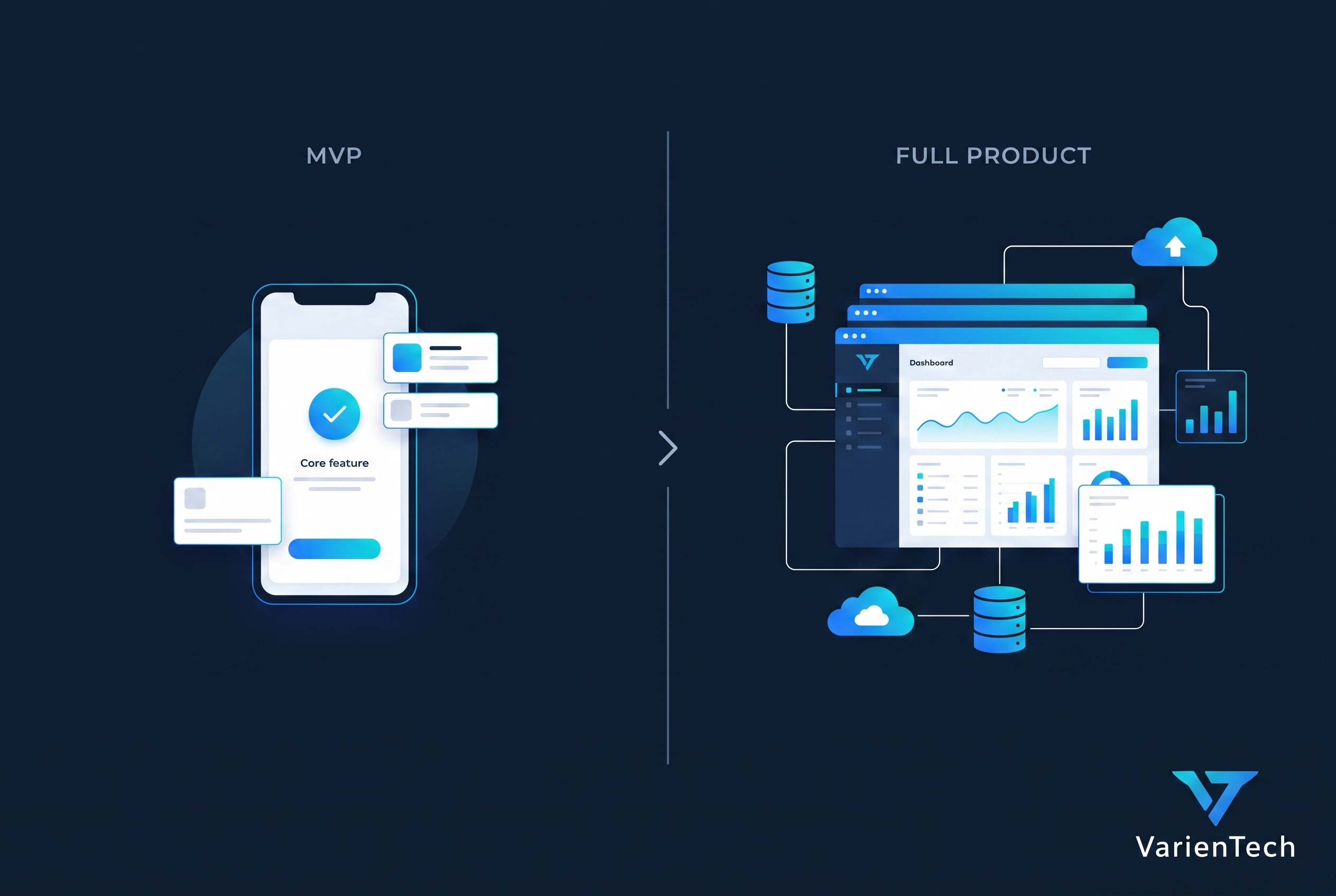
The MVP vs full product question is the first serious engineering decision most founders face, and getting it wrong is expensive in both directions. Build too little and you launch something nobody takes seriously. Build too much and you spend a year and most of your runway perfecting features your market never asked for. This guide breaks down what each approach really costs, which one fits your situation, and how to scope a first release that earns its way into a full platform.
What “MVP” and “Full Product” Actually Mean
A minimum viable product is the smallest complete version of your idea that a real user can pay for, rely on, or get value from. The key word is viable, not minimum. An MVP is not a prototype, not a clickable mockup, and not a half-finished app with broken buttons. It is a narrow product that does one important job properly.
A full product is the mature version: multiple user roles, integrations, admin tooling, analytics, billing tiers, mobile apps, compliance work, and everything else a scaled customer base demands. It is what your MVP should eventually become, not what it should launch as.
Why Most Startups Should Build an MVP First
It tests demand before it burns your budget
The most common reason startups fail is not bad code. According to CB Insights’ analysis of startup post-mortems, “no market need” is the single largest contributing factor, cited in roughly 35% of failures. An MVP converts that risk into evidence early, while you still have money and time to act on what you learn.
It gets you to revenue and feedback faster
A focused MVP typically ships in 8 to 16 weeks. A full platform build is realistically 9 to 18 months. Those extra months are not free — they are months of salary, hosting and opportunity cost spent on assumptions rather than customers. Shipping early means real usage data, real objections, and often real revenue while competitors are still in design review.
It makes your roadmap evidence-based
Once people use your software, prioritisation stops being an argument and starts being arithmetic. You stop guessing which features matter and start reading it off your own analytics and support inbox. Teams that skip this step routinely build elaborate modules that see single-digit adoption.
When Building the Full Product First Is the Right Call
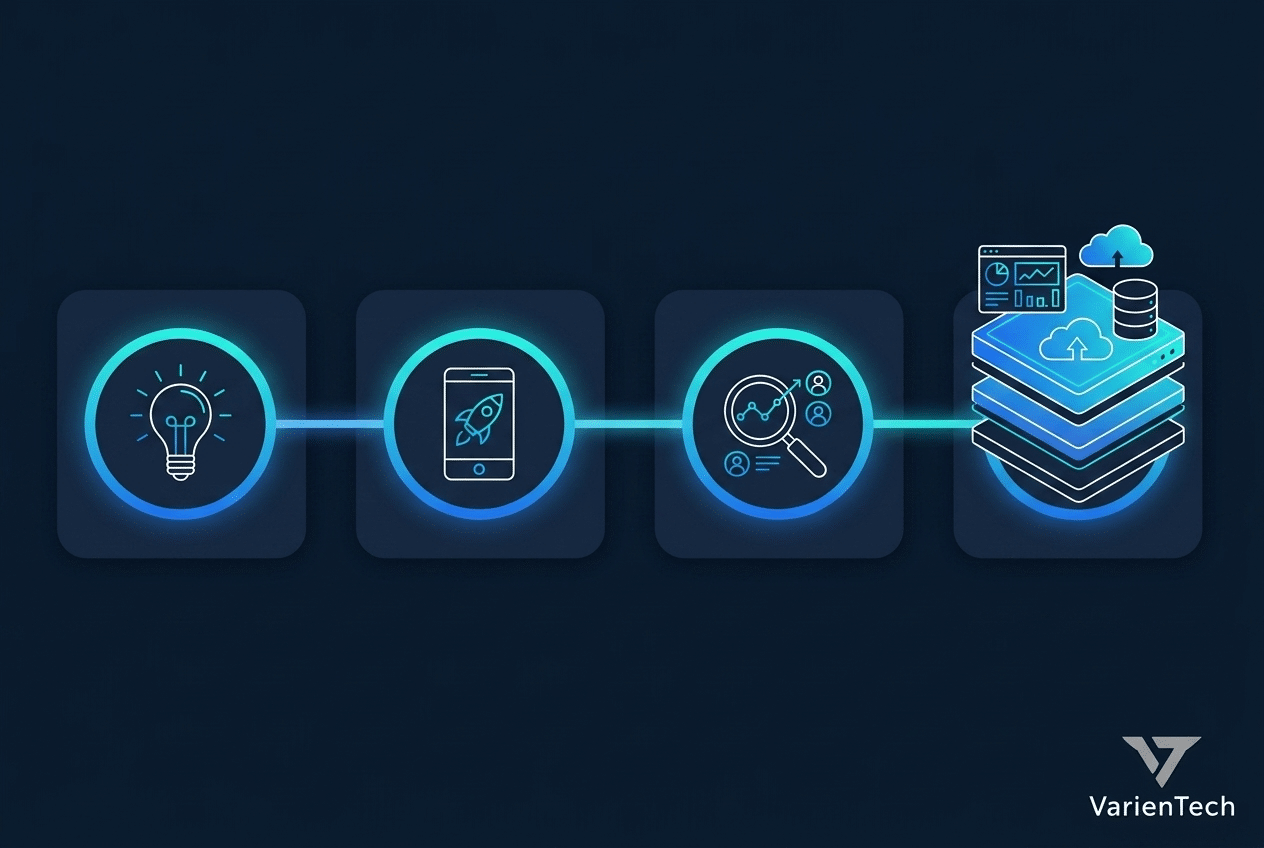
The MVP-first default is not universal. Building closer to a complete product from day one makes sense when:
- You are in a regulated industry. Fintech, healthcare and legal software often cannot ship a “partial” product legally. Compliance, audit trails and data handling are table stakes, not phase two.
- Your buyers are enterprises. Procurement teams evaluate SSO, role-based access, uptime guarantees and security documentation before they evaluate your idea. A stripped-back MVP will not clear a vendor review.
- The core value only appears at scale. Marketplaces, logistics networks and data platforms sometimes deliver nothing useful until several components exist together.
- The market is already proven and crowded. If you are entering a mature category, an MVP that is visibly weaker than incumbents will not win trials on novelty alone.
Even in these cases, the answer is rarely “build everything”. It is usually a narrower scope at a higher completeness bar: one workflow, done to production standard.
MVP vs Full Product: A Side-by-Side Comparison
| Factor | MVP | Full Product |
|---|---|---|
| Typical timeline | 8–16 weeks | 9–18 months |
| Primary goal | Validate demand | Capture and retain a market |
| Feature scope | One core workflow | Multiple roles, integrations, admin tooling |
| Capital at risk | Low | High |
| Best for | Unproven ideas, new categories, seed-stage teams | Regulated sectors, enterprise buyers, proven demand |
| Biggest risk | Shipping something too thin to judge fairly | Building the wrong thing beautifully |
How to Scope an MVP That Is Not a Throwaway
The fear behind the MVP vs full product debate is usually the same: that the first version will be disposable code you pay to rebuild. That happens when the MVP is treated as a demo rather than a foundation. Avoid it with four rules:
- Pick one user and one job. Write it as a sentence: “A warehouse manager can reconcile a delivery against a purchase order in under two minutes.” Everything that does not serve that sentence is phase two.
- Cut features, never quality. Fewer screens is fine. Broken auth, no tests and no error handling is not. Production-grade code on a small surface area is what makes an MVP extensible.
- Choose boring, scalable architecture. A well-structured monolith on managed infrastructure will carry you to tens of thousands of users. Premature microservices will not.
- Instrument it from day one. Analytics, error tracking and a feedback channel are MVP features. Without them you ship blind and learn nothing.
If you are handing the build to an outside team, scope discipline matters even more — see our breakdown of the most common mistakes companies make when outsourcing software development.
Signals It Is Time to Move From MVP to Full Product
Scale when the evidence tells you to, not when the calendar does. Reliable signals include:
- Retention holds steady after the novelty period — users come back in week four, not just week one.
- Customers are asking for specific missing features rather than asking what the product is for.
- You are losing identified deals to a named gap, such as an integration or a permissions model.
- Manual workarounds behind the scenes have become the bottleneck on growth.
- Unit economics work at small scale, so more volume means more margin rather than more loss.
If none of these are true yet, more features will not fix it. Revisit the core value proposition instead.
Common Mistakes in the MVP vs Full Product Decision
- Confusing “minimum” with “low quality.” Users forgive a small product. They do not forgive a broken one.
- Building for the investor demo instead of the user. Impressive breadth wins meetings and loses retention.
- Skipping the discovery work. A week of customer interviews routinely removes a month of development.
- Never leaving MVP mode. The opposite failure: staying deliberately minimal for two years while a competitor builds the platform your customers wanted.
Frequently Asked Questions
How much does an MVP cost to build?
For a well-scoped single-workflow product, most startups should budget for a 2–4 person team over 8–16 weeks. The cost varies widely by region and complexity, but the scope discipline matters far more than the hourly rate.
Can an MVP become the full product, or is it always rebuilt?
It can and should become the full product, provided it was built to production standards with sensible architecture. Rebuilds are the result of shortcuts taken under deadline pressure, not of the MVP approach itself.
How many features should an MVP have?
As few as possible while still completing one end-to-end job for one user type. In practice this is often three to five screens, plus authentication and basic analytics.
Is an MVP still relevant when AI can build software faster?
More relevant, not less. Faster development lowers the cost of building the wrong thing, which makes validating demand the real constraint. Speed only helps if you are pointed in the right direction.
The Bottom Line
For most startups, the MVP vs full product answer is: build the MVP, but build it properly. Narrow the scope aggressively, keep the engineering quality high, instrument everything, and let real usage decide what gets built next. Reserve the full-build approach for regulated, enterprise or network-dependent products where a partial release genuinely cannot work.
At VarienTech we help founders scope that first release, ship it in weeks rather than quarters, and grow it into a full platform without a rewrite. Talk to our team about what your first version should include.

2 Responses