
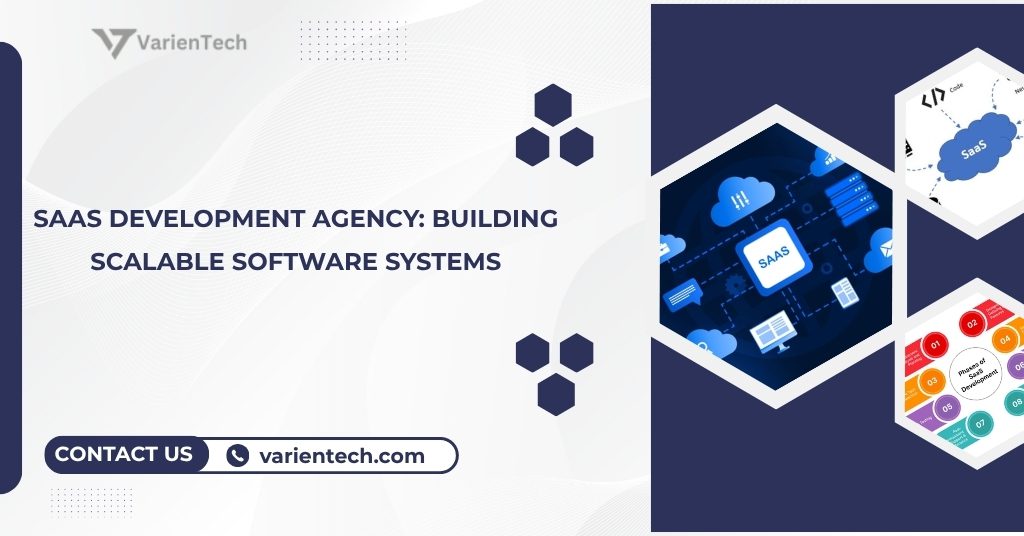
A SaaS development agency is more than a software vendor. It is a purpose-engineering partner that designs, builds, scales, and optimizes SaaS (Software as a Service) cloud-native software products on which businesses today depend. As SaaS is at the forefront of innovation, given that we now live in a subscription economy where one can find platforms to create subscriptions for industries spanning fintech and education/healthcare.
In this post, we discuss what the modern SaaS development agency does, how it works under the hood, what separates top-tier agencies from just average ones, and why more businesses rely on them to build multi-million-dollar software ecosystems.
What is a SaaS Development Agency Anyway (Other Than Buzzwords)?
A SaaS development agency inherently builds multi-tenant cloud software systems—apps to which multiple users or companies log in, but each with segregated data and customizable experiences.
And that barely scratches the surface of what we mean by that definition.
A reputable SaaS development company takes care of:
- What to build and why (product strategy)
- Systems architecture (how does it scale worldwide)
- UX/UI (how users will interact with it)
- Backend engineering e.g., APIs, databases or logic systems
- Cloud deployment is well-known (AWS, Azure, GCP infrastructure)
- Security engineering (authentication, encryption, compliance)
- DevOps / CI/CD pipelines (continuously deliver system)
- Long-term scaling and maintenance
Their use of the term is in such a way that they do not simply “code software,” but rather design living systems, which evolve with actual user demand.
The SaaS Mindset: How This Approach Differs from Traditional Software Development
SaaS makes you work in completely different ways than building websites, mobile apps or internal tools.
A SaaS development company needs to build for
Continuous usage (not one-time installation)
SaaS is something users don’t download—it’s something they live with every day. So uptime, reliability and performance are off the table.
Multi-tenancy
Another system is meant to handle thousands/millions of businesses or users securely without any data corruption/side-channeling and with the necessary performance.
Subscription economics
Success in SaaS: More than Just Launch, but Rather Retention. Agencies have to consider churn, onboarding flow and lifetime value of the user.
Infinite scalability
A product to get started: how you can,, for example, start it with 100 users and grow into 10 million users. That transition should be done by the architecture without rewrites.
Instead of “project-based coding,” this mindset shifts SaaS development to product-engineering at scale.
The Hidden Engineering Layers in a SaaS Development Agency
To the user, a high-level SaaS platform seems rather simple. However, under the hood, it is a tiered architecture of dependent engineering disciplines.
Layer 1: Product Engineering
That is where ideas are turned into features. Agencies internally convert the business requirements into the working of a system, defining workflow, user journeys and logic for features.
Layer 2: Backend Architecture
First and foremost, this is the main brain of all SaaS systems:
- Microservices or monolithic APIs
- Database Design: SQL vs NoSQL decisions
- Authentication systems (OAuth, JWT, SSO)
- Business logic execution
Layer 3: Frontend Experience
Modern SaaS UI isn’t just design—it’s interaction logic:
- Dashboards
- Real-time updates
- Multi-device responsiveness
- Data visualization layers
Layer 4: Cloud Infrastructure
SaaS runs on cloud platforms:
- AWS, Google Cloud, or Azure
- Auto-scaling systems
- Load balancing
- Containerization (Docker, Kubernetes)
Layer 5: DevOps & Automation
Agencies build pipelines that allow:
- Continuous deployment
- Automated testing
- Instant rollback systems
- Monitoring and alerts
Layer 6: Security & Compliance
This is where enterprise SaaS gets serious:
- Encryption of data both in transit and at rest
- GDPR, HIPAA compliant (based on industry)
- Role-based access control
- Threat detection systems
Now, an agency doing saas development would work on all these layers at one go.
Why Businesses Opt to Hire SaaS Development Agencies Instead of Building In-House
A lot of founders think that hiring an internal dev team is less expensive. The truth is, SaaS development agencies exist due to the reason of addressing other deeper structural issues.
Speed to Market
Agencies already have:
- Reusable architectures
- Pre-built authentication systems
- Scalable deployment pipelines
This significantly shrinks development time from years to months.
Cross-Industry Experience
A reputed SaaS agency has developed popular products in sectors such as fintech, health care plans, logistics and e-studying. This cross-domain experience is what prevents costly mistakes.
Reduced Technical Risk
Architecture choices made in the first 6 months cause most startups to fail. Agencies focus on steering away from those initial design fails.
Access to Senior Talent
Instead of hiring additional developer(s), companies can access:
- System architects
- Cloud engineers
- Product engineers
- Security specialists
Focus on Core Business
Founders can focus on marketing, sales and growth instead of debugging infrastructure problems.
What Sets a Premium SaaS Development Agency Apart
Not all agencies are equal. Some build basic CRUD apps. Others build billion-dollar-ready systems.
This is the main differentiator between average SaaS agencies and elite ones:
Architecture-First Thinking
Leading agencies do not begin with code; they start with system design diagrams:
- At 10 users, how would the system perform?
- At 10,000 users?
- At 10 million users?
They design backwards from scale.
Modular Product Design
Rather than create one great big system, they take a course of action called the following:
- Independent services
- Reusable components
- API-first architecture
This makes future expansion easier.
Data-Driven Engineering
Metrics support every decision:
- User retention rates
- Feature adoption tracking
- Performance benchmarks
Engineering becomes measurable, not subjective.
Built-in Monetization Logic
Not that advanced SaaS agencies build software; they integrate the following:
- Subscription systems
- Usage-based billing
- Tiered pricing models
- Payment gateways (Stripe, Paddle, etc.)
- Serves product-ready from day 1 (revenue-ready)
Real-Time Systems Expertise
Real-time functionality is a must for modern SaaS platforms:
- Live chat systems
- Collaborative editing tools
- Real-time dashboards
- Event-driven architectures
It involves complex engineering, much more than web development.
Most Used Technologies by SaaS Development Agencies
It differs per field, but some common technologies are the following:
Frontend: React, Next. JS, Vue.js
Backend: Node.js, Python (Django/FastAPI), Go
Databases: PostgreSQL, MongoDB, Redis
Cloud: Amazon Web Services, Google Cloud Platform, Microsoft Azure
DevOps: Docker, Kubernetes, Terraform
Authentication — Auth0, Firebase Auth or custom OAuth systems
Payments: Stripe, Paddle, Braintree
However, the true power does not lie in the tools themselves, but rather in how they are put together to form a repeating system.
Zero to Scale: The SaaS Product Lifecycle Agency Model
Usually, a professional SaaS software development agency pursues an organized lifecycle of following:
Phase 1: Discovery & Strategy
- Market research
- Competitor analysis
- Feature mapping
- MVP definition
Phase 2: Architecture Design
- System diagrams
- Database design
- API structure
- Scaling strategy
Phase 3: MVP Development
- Core feature implementation
- Minimal viable UI
- Basic integrations
Phase 4: Testing & Optimization
- Load testing
- Security testing
- UX optimization
Phase 5: Launch
- Cloud deployment
- Monitoring setup
- User onboarding systems
Phase 6: Scaling
- Performance optimization
- Feature expansion
- Infrastructure scaling
This lifecycle is continuous—not linear.
SaaS Agency Not Having SaaS At All: 3 Mistakes Businesses Make
So, the companies that attempt to make it alone on SaaS usually encounter the following:
- Bad versions of databases result in slow systems
- Scalability issues are still crashing at load
- Data breaches due to inadequate security
- Over-engineering MVPs that never launch
- Inability to monetize properly
- Technical debt that becomes unfixable
It is more expensive to fix these issues later than to normalize them in the first place.
Future of SaaS Development Agencies
SaaS agencies are transforming at the moment.
AI-Integrated SaaS Development
Agencies now integrate:
- AI copilots
- Automated customer support systems
- Predictive analytics engines
No-Code + Pro-Code Hybrid Systems
Modern agencies combine:
- No-code tools for speed
- Custom code for scalability
Vertical SaaS Specialization
Rather than generic SaaS, agencies are forming niche solutions for:
- Legal tech
- Health tech
- Real estate tech
- Fintech ecosystems
Product-Led Growth Engineering
Now, the agencies design SaaS systems to grow by themselves through:
- Viral loops
- Referral systems
- Freemium models
Conclusion
A SaaS software development agency is not just a software contractor. A deep technical and strategic partner who transforms ideas into scalable innovations—revenue-driving digital ecosystems. Top agencies like VarienTech sit at the crossroads of engineering, product strategy, cloud architecture and business growth.
As software gets embedded into almost every industry, SaaS development agencies don’t just halt at an optional entity, but in fact are the pillars. Those businesses that get this don’t build apps; they create platforms that grow, scale and conquer markets over time.
FAQs
1. What does a SaaS development agency do?
A SaaS development agency designs, builds, and scales cloud-based software products that users access online. It handles everything from product strategy and UI/UX design to backend development, cloud infrastructure, security, and long-term maintenance.
2. How is a SaaS development agency different from a normal software development company?
A traditional software company often builds general apps or websites, while a SaaS development agency focuses specifically on scalable, subscription-based cloud platforms. SaaS agencies design systems for long-term growth, multi-user access, and continuous updates.
3. How long does it take to build a SaaS product?
The timeline depends on complexity. A basic MVP can take 2–4 months, while a fully scalable SaaS platform with advanced features, integrations, and security layers can take 6–12 months or more.
4. Why do startups hire SaaS development agencies instead of building in-house teams?
The timeline depends on complexity. A basic MVP can take 2–4 months, while a fully scalable SaaS platform with advanced features, integrations, and security layers can take 6–12 months or more.
5. What technologies are commonly used in SaaS development?
SaaS development agencies typically use technologies like React or Next.js for frontend, Node.js or Python for backend, PostgreSQL or MongoDB for databases, and cloud platforms like AWS, Google Cloud, or Azure for hosting and scaling.

2 Responses