
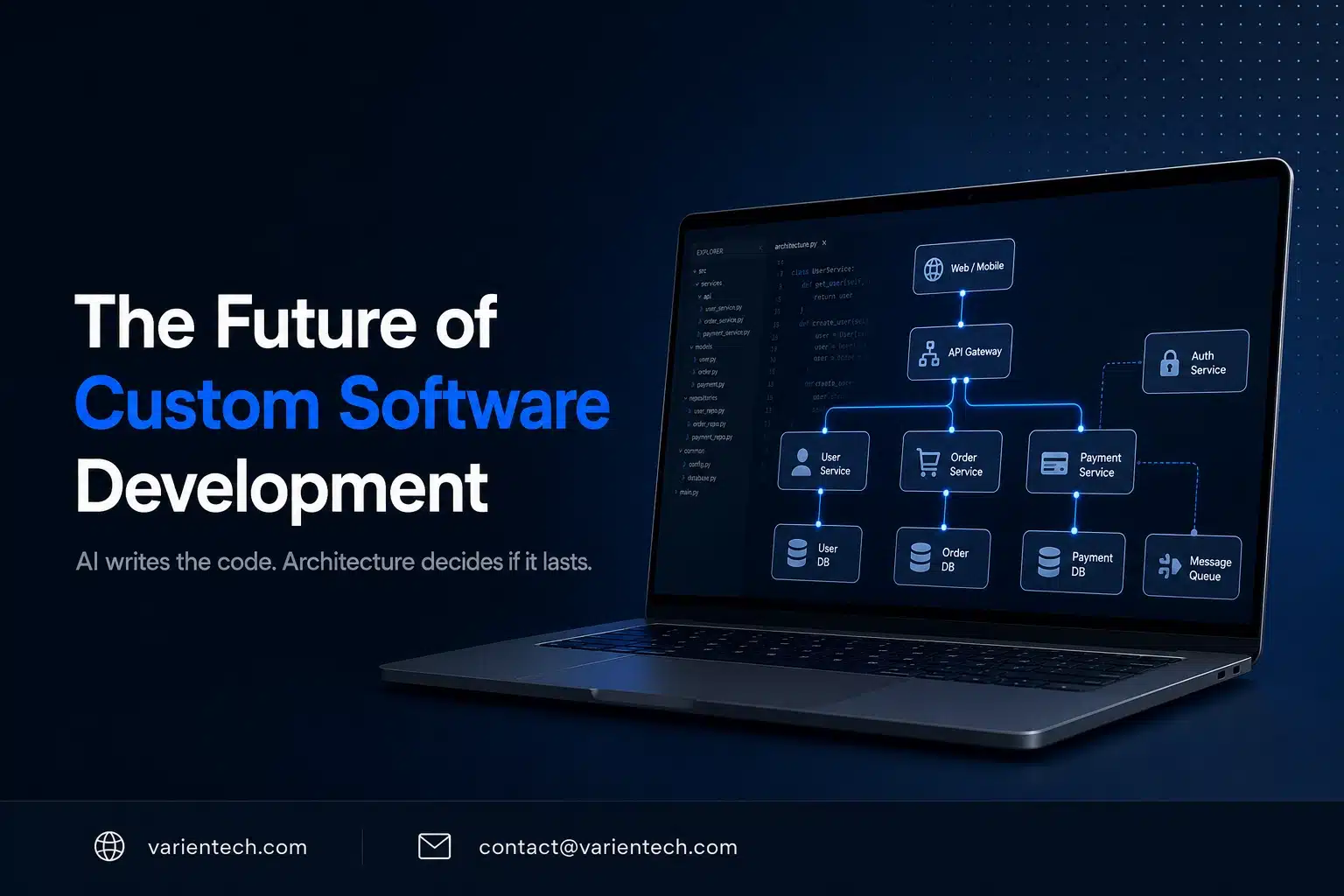
Every few years something arrives that developers are told will replace them. This time the claim landed harder, because the tooling is genuinely good. But the businesses commissioning software have a more practical question than “will AI write the code” — they want to know what they should be buying, and what it needs to survive. The future of custom software development isn’t about whether code gets written by a human or a model. It’s about what happens to the code after it ships.
Here’s the uncomfortable part: writing software was never the expensive bit. Maintaining it, securing it, integrating it, and changing it as the business changes — that’s where the budget goes. AI has made the cheap part cheaper and left the expensive part largely untouched. Understanding that gap is the whole strategy.
What the Future of Custom Software Development Actually Looks Like
The market itself isn’t shrinking. The custom software development market is projected to reach roughly USD 65 billion in 2026 and grow at over 20% annually through the next decade, and enterprise AI spending is accelerating alongside it — Gartner forecasts the worldwide AI platforms and models market will grow 63% in 2026. Demand for bespoke software is rising, not falling. What’s changing is what “custom” means and where the value sits.
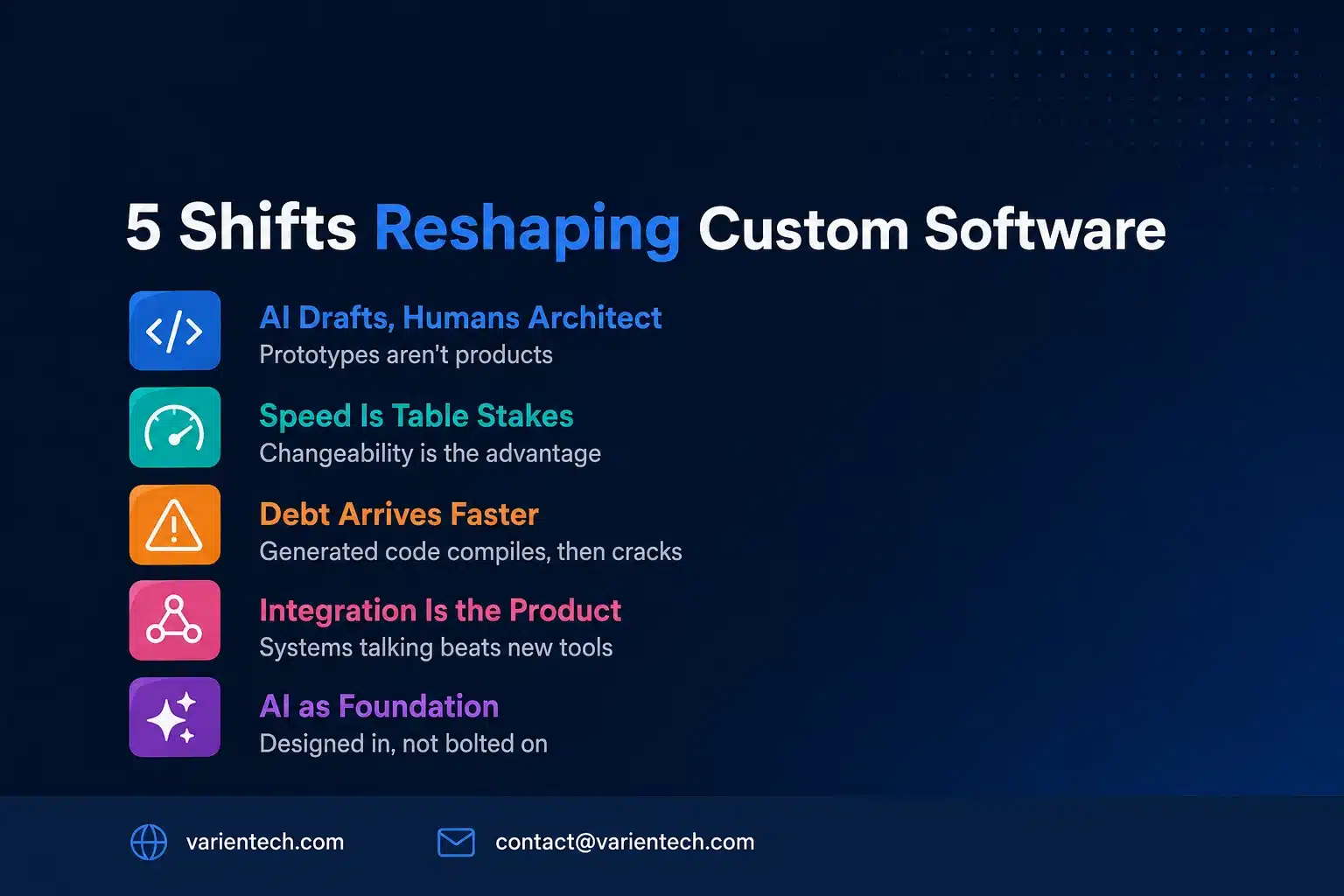
Five shifts are doing most of the work:
- AI writes the first draft, not the system. Roughly half of newly written code is now AI-assisted. That compresses the timeline from idea to working prototype dramatically — but a prototype isn’t a product. Architecture, data modeling, and integration decisions still determine whether the thing survives its second year.
- Speed to first version stops being a differentiator. When everyone can ship an MVP in weeks, being fast is table stakes. The advantage moves to teams who can change software quickly six months later without breaking it.
- Technical debt arrives faster and quieter. Generated code compiles, passes review, and looks fine. It also accumulates inconsistencies that surface as brittle systems and security gaps later. Teams shipping faster without stronger review are just reaching the maintenance wall sooner.
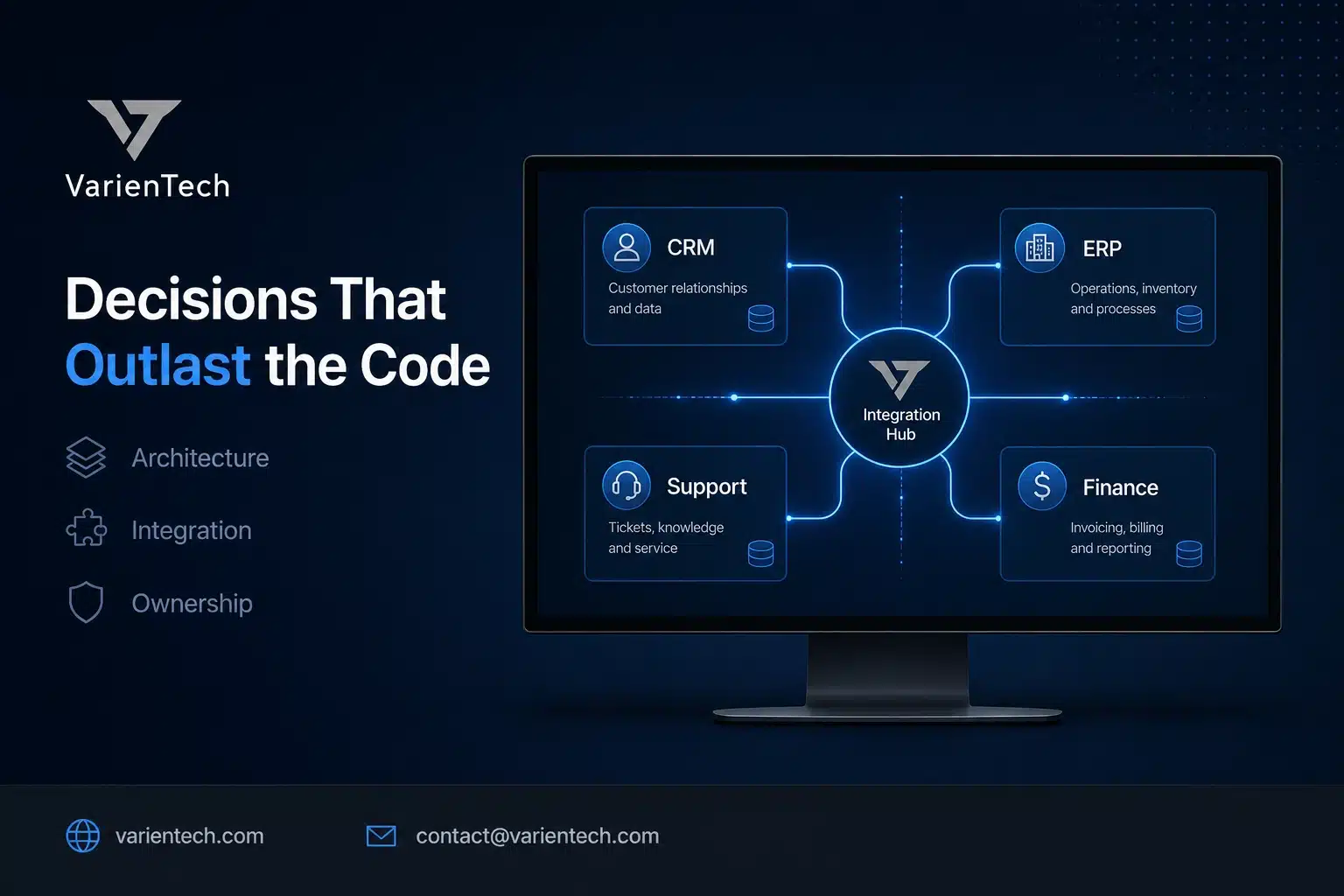
- Integration becomes the actual product. Most businesses don’t need new software so much as they need their existing systems to talk to each other. The valuable builds are increasingly the connective layer — CRM to ERP to support to finance — not another standalone tool.
- AI moves from feature to foundation. Bolting a chatbot onto a finished product is the old approach. Software built now assumes AI in the workflow from day one, which is an architectural decision, not a feature request.
Why “AI Will Replace Developers” Misreads the Problem
Code generation solves the typing problem. It doesn’t solve the deciding problem.
Someone still has to determine how data flows between systems, what happens when a third-party API changes, which edge cases matter in your specific industry, how the system scales past its first thousand users, and where the compliance obligations sit. Those decisions cost more to get wrong than any amount of code costs to write.
Gartner’s own forecasting points the same direction — the projection that most technology products will soon be built by people who aren’t professional developers is a statement about who assembles software, not about who is accountable for it holding up. Accountability doesn’t get automated.
The practical version: AI has made building software faster. It has not made building the right software easier. If anything, cheaper prototyping means more businesses now own several half-finished tools that nobody wants to maintain.
What This Means for the Software You Commission
If you’re planning a build in the next 12 months, the questions that matter have moved. Not “how quickly can you ship this” — most credible teams can now ship quickly. Ask instead:
- What happens when we need to change this in a year? The answer reveals whether the architecture was designed or improvised.
- How does it connect to what we already run? A tool that doesn’t integrate creates a new silo and a new manual process — the exact thing you were trying to remove.
- Who owns it after launch? Handover, documentation, and maintenance ownership matter more than the build timeline.
- Where does AI genuinely help, and where is it decoration? AI in the workflow where it removes real manual effort pays for itself. AI as a marketing checkbox costs you support burden.
- What’s the three-year cost, not the launch cost? Off-the-shelf and custom both look different when you run the numbers past year one.
How We’re Building For It
The future of custom software development rewards systems designed to be changed. When we built Goyzer’s AI-powered real estate management platform, the durable part wasn’t any single feature — it was that AI-driven tools were designed into daily workflows from the start rather than bolted on afterward. That’s why it scaled to 200+ client operations across the UAE instead of needing a rebuild at the first growth spike.
The same principle applies at smaller scale. Build the connective tissue first. Design for the change you can’t predict yet. Put AI where it removes manual effort, not where it demos well. None of that is new advice — it’s just that AI-accelerated delivery has made ignoring it much more expensive.
Frequently Asked Questions
Will AI replace custom software development companies?
No — but it’s changing what they’re paid for. AI compresses the code-writing stage, which shifts the value toward architecture, integration, security, and long-term maintainability. Teams that only offered coding capacity are under pressure; teams that offer engineering judgment aren’t.
Is custom software still worth it when off-the-shelf tools have AI features?
It depends on where your bottleneck is. If a standard tool matches your workflow, use it. Custom becomes worth it when your process is a competitive advantage, when per-seat pricing scales badly against your headcount, or when the real problem is getting several existing systems to work as one.
What does the future of custom software development mean for maintenance costs?
Expect maintenance to become a larger share of total cost, not a smaller one. Faster delivery produces more software per business, and more software means more surface area to secure, update, and integrate. Budget for the decade, not the launch.
How should businesses prepare for AI-native software?
Start by identifying which workflows are genuinely repetitive and rule-based, then build or integrate around those first. AI added to a well-understood process delivers returns; AI added to an unclear process just makes the confusion faster.
Planning a build and want a straight answer on what’s worth customizing? Talk to our team at varientech.com/contact-us. You might also like our related guides on why every business needs AI integration in 2026 and how AI automation reduces operational costs.

One Response