
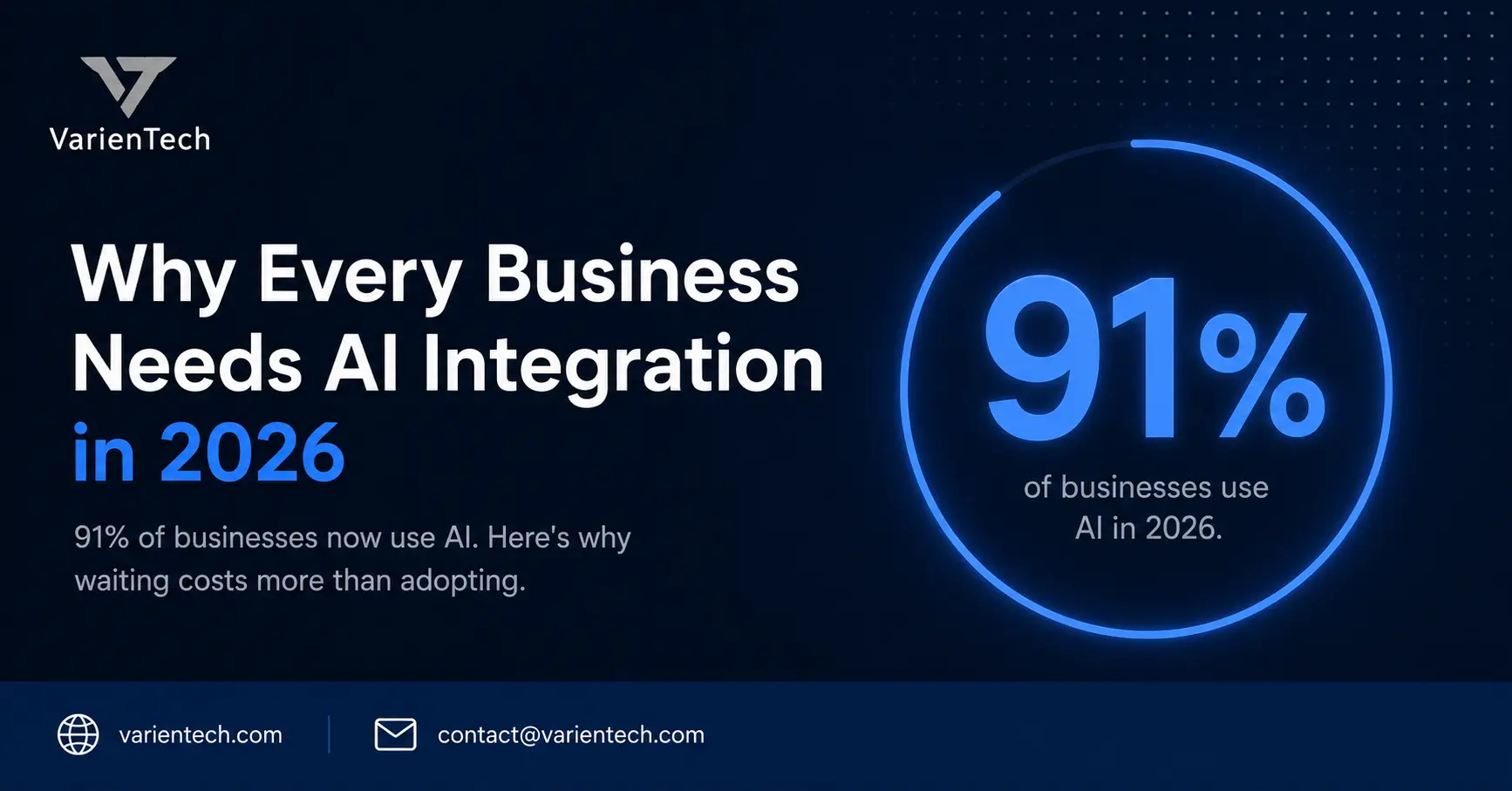
Two years ago, AI integration was a differentiator. In 2026, AI integration for business is table stakes.
91% of businesses now use AI in at least one part of their operations, up from 78% in 2024. Among small businesses specifically, generative AI usage jumped from roughly 40% in 2024 to more than 58% today, and 63% of small business owners report using AI tools daily. The businesses still treating AI as optional aren’t just behind a trend — they’re competing against companies that have already cut their operating costs and response times.
This isn’t a story about replacing people with software. It’s a story about what happens when the businesses around you stop doing manual work that AI can now do faster, cheaper, and around the clock.
The Numbers Behind the Shift
A few data points explain why 2026 is the year AI integration stopped being optional:
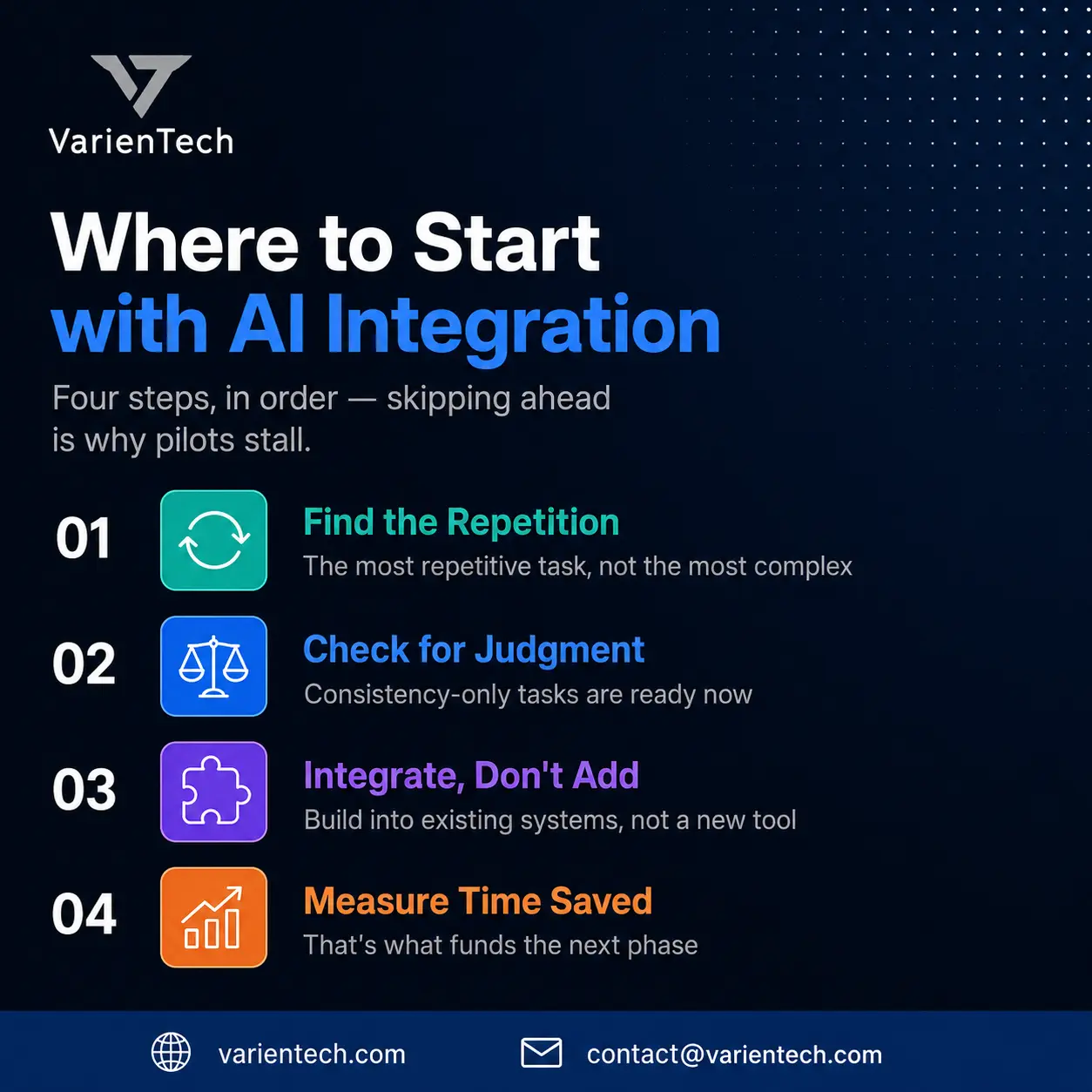
- Small businesses using AI report an average ROI of 3.7x on their AI investment, and 91% report measurable revenue increases tied to it.
- Businesses using AI are 2.3 times more likely to report revenue growth than businesses that aren’t.
- 83% of growing small and mid-sized businesses have adopted AI, compared to just 55% of declining ones.
- Most small businesses see their first measurable ROI within 60 days — usually in marketing or customer service, where repetitive, high-volume tasks are easiest to automate first.
The pattern is consistent: adoption correlates with growth, and the payback period is short enough that waiting has become the riskier choice.
Why “We’ll Get to It Eventually” No Longer Works
The businesses delaying AI integration usually aren’t against it in principle — they’re waiting for a better time, a bigger budget, or more internal expertise. Three things make that wait more expensive than it looks:
Your competitors’ response times are dropping. When a competitor uses an AI-powered support agent to answer customer questions in seconds instead of hours, “we’ll respond within 24 hours” stops being an acceptable standard in your market — not just theirs.
Manual work compounds. Every week a team spends manually reconciling data, answering the same support questions, or building reports by hand is a week that doesn’t get cheaper by waiting. The cost of manual process debt goes up as the business grows, not down.
Integration complexity grows with your systems. The longer a business waits, the more disconnected tools, spreadsheets, and one-off scripts accumulate around its core systems — and the harder (and more expensive) proper AI integration becomes later. Integration complexity is already the top blocker cited by 56% of companies attempting AI adoption; that number only gets worse the more fragmented systems become.
What AI Integration for Business Actually Means
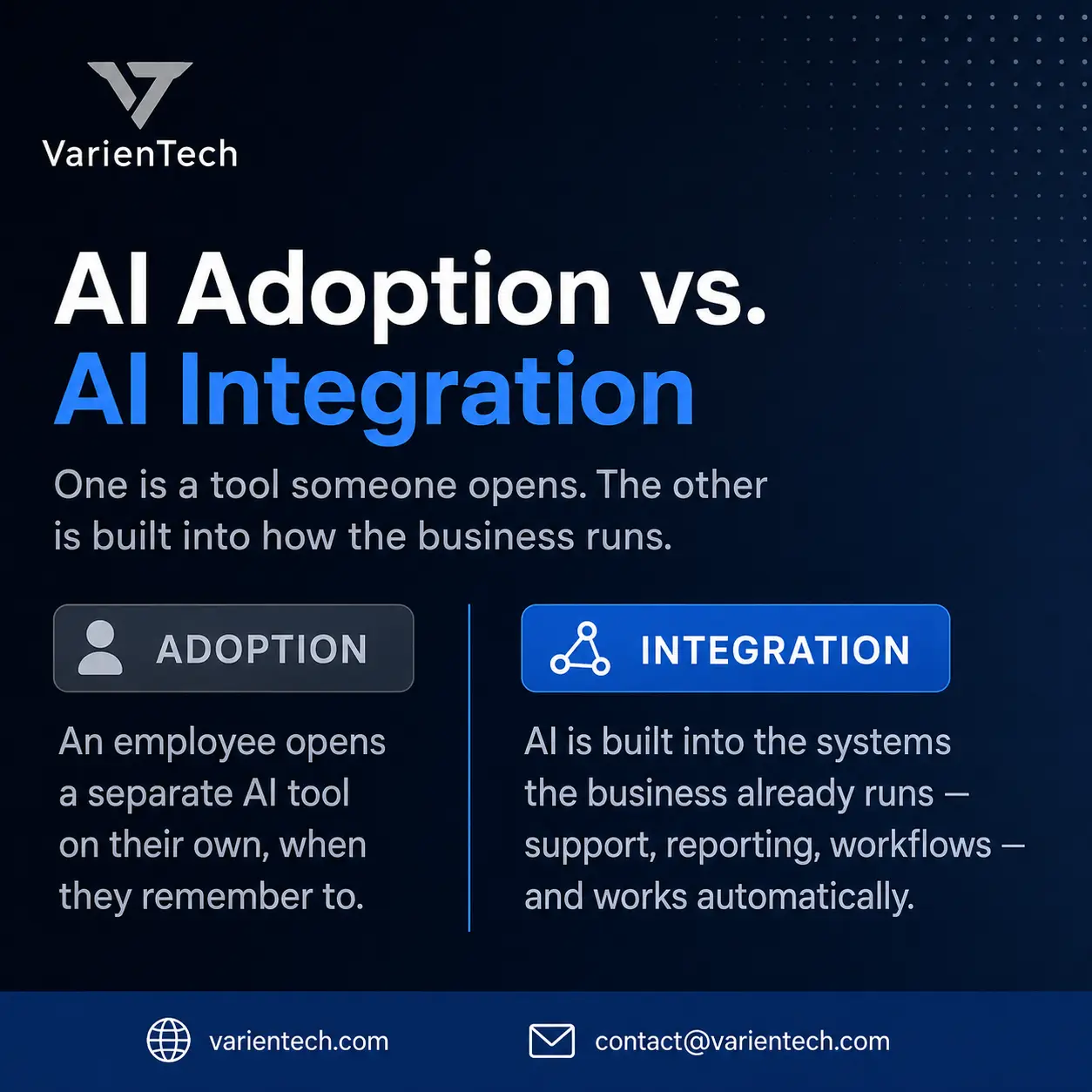
AI integration isn’t buying a ChatGPT license and telling employees to use it. That’s AI adoption at the individual level — useful, but shallow. Integration means embedding AI into the systems a business already runs on, so it works without anyone having to remember to open a separate tool:
- Customer support — AI agents that resolve routine tickets and route complex ones to a human, instead of a support inbox that grows faster than the team can answer it.
- Data and reporting — AI that turns raw operational data into a plain-language summary automatically, instead of a weekly manual report someone dreads building.
- Internal knowledge — AI search across a company’s own documents and systems, so employees get an answer instantly instead of pinging three people on Slack.
- Workflow automation — AI agents that handle scheduling, data entry, approvals, and follow-ups that currently eat hours of a team’s week.
The businesses seeing the strongest ROI are the ones that picked one or two of these — usually the most repetitive, highest-volume workflow — and integrated AI directly into it, rather than trying to “adopt AI” everywhere at once.
Where to Start If You Haven’t Yet
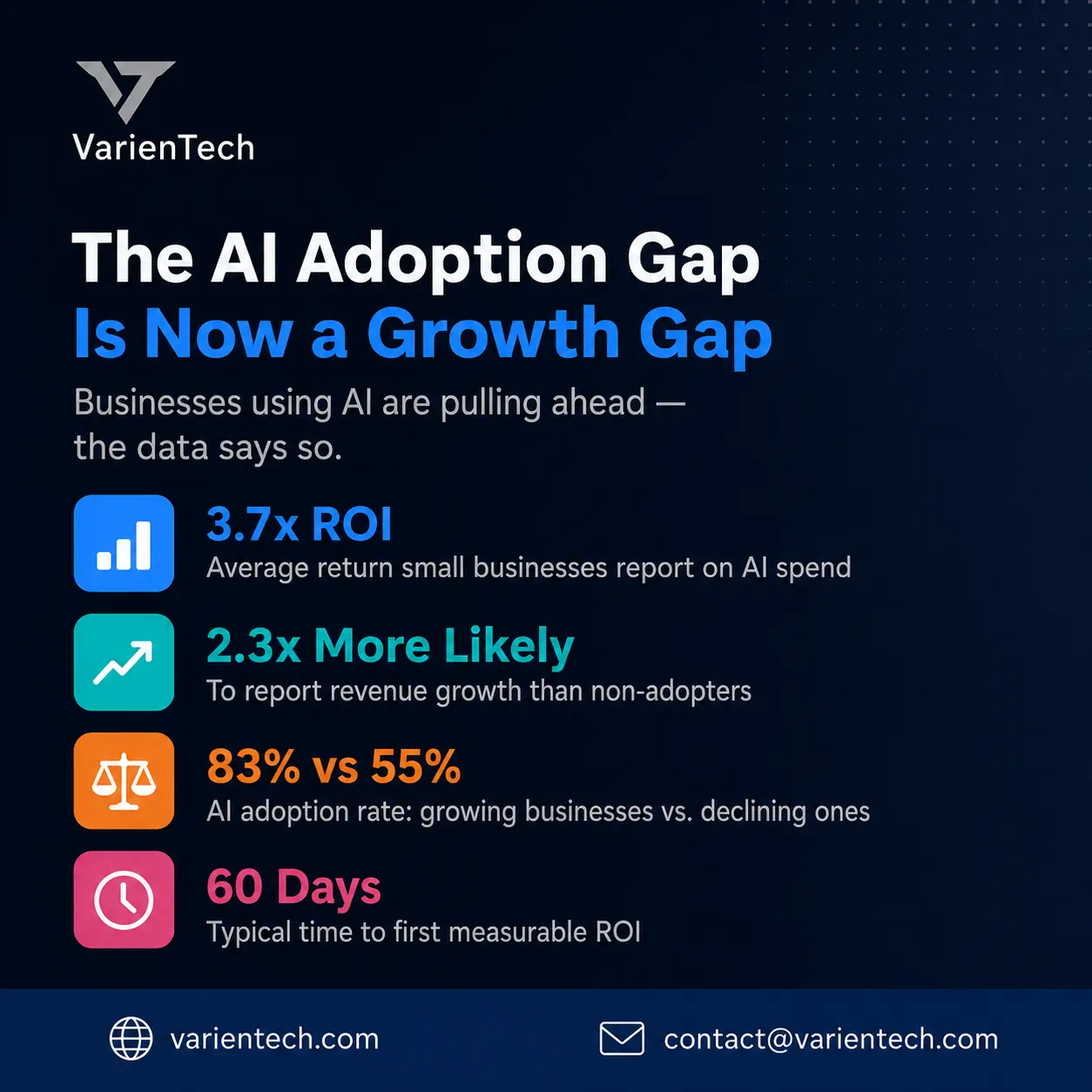
If AI integration still feels like a 2027 problem, the practical starting point looks like this:
- Find the most repetitive, rule-based task your team does. Not the most complex one — the most repetitive one. That’s usually where AI delivers value fastest.
- Check whether it needs judgment or just consistency. Tasks that need consistency more than judgment (data entry, routine replies, status updates) are ready for automation now.
- Integrate it into the system you already use, rather than adding another standalone tool employees have to remember to check.
- Measure the time saved, not just whether the AI “worked.” The ROI case is what gets the next phase funded.
This is deliberately narrow. Businesses that try to integrate AI everywhere at once are the ones stuck in “pilot purgatory” — the roughly two-thirds of companies that have started experimenting with AI but haven’t scaled it past a single team or use case.
The Bottom Line
AI integration in 2026 isn’t about keeping up with a buzzword. It’s about whether a business’s operating costs, response times, and decision-making speed keep pace with competitors who’ve already made the shift. The data shows growing businesses adopt AI at a meaningfully higher rate than declining ones — that’s not a coincidence, it’s a leading indicator.
The businesses that treat 2026 as the year they finally integrate AI into how they actually operate — not just as a tool employees dabble with — are the ones that will set the pace their competitors have to match.
Frequently Asked Questions
Does every business really need AI integration in 2026?
Not every business needs AI everywhere, but most businesses now have at least one workflow — customer support, reporting, or repetitive data entry — where AI integration pays for itself within 60 days. The 9% of businesses with zero AI usage are increasingly the exception, not the norm.
What’s the difference between using AI tools and AI integration?
Using AI tools means an employee opens ChatGPT or a similar app on their own. AI integration means AI is built into the systems and workflows a business already runs on, so it works automatically without someone remembering to use it separately.
How fast can a small business see ROI from AI integration?
Most small businesses report their first measurable ROI within 60 days, typically in marketing or customer service — the areas with the highest volume of repetitive tasks.
What’s the biggest risk of waiting to integrate AI?
The main risks are competitive, not technical: competitors’ faster response times reset customer expectations, manual process costs compound as the business grows, and systems become more fragmented and expensive to integrate the longer a business waits.
Whether we’re modernizing legacy software, delivering enterprise AI development, or implementing intelligent workflow automation, that’s the philosophy behind everything we build at VarienTech. If your business hasn’t started integrating AI into how it actually operates, let’s talk about where to start.

3 Responses